Open question
What happened before the Big Bang?
Nobody knows. Our best theory of gravity stops working at the first instant, so it cannot say what came before, or whether “before” means anything. What scientists do have is a handful of serious ideas, and they are not all equally well supported.
The Big Bang theory describes how the universe grew from a hot, dense state, and it is one of the best-tested ideas in science. It does not describe an origin from nothing. That part is open. Below are seven attempts to answer it, ordered from the best supported to the most speculative. Each one has a small 3D model you can open and fly around.
How to read the ratings
Every idea carries one of five ratings, so you can tell a measurement from a guess.
- MeasuredDirectly observed or measured, again and again.
- Strong evidenceSeveral independent kinds of observation point to it. Scientists are still refining the details.
- Leading theoryThe best current explanation. It fits the data well, but other ideas are still alive.
- Proposed, testableA real proposal that predicts something we could look for. The test has no clear result yet.
- SpeculativeAn idea that fits some theory but has no observation behind it yet, and no clear test.
Nothing on this page reaches the top two ratings. That is the honest state of the science.
Cosmic inflation
 Open this model in 3D →
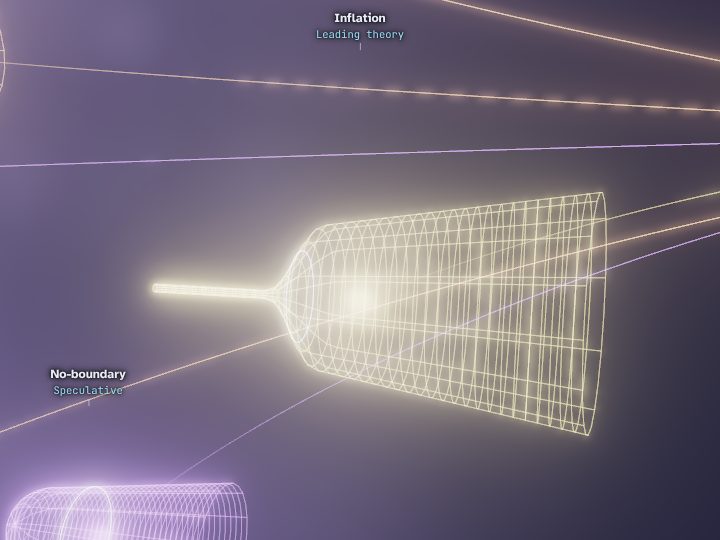
A burst of super-fast stretching in the first instant. It is not really “before” the Big Bang. Most physicists see it as the Big Bang’s first moments. It explains the smooth, flat, slightly lumpy universe we measure.
The simplest inflation models predict a nearly scale-invariant spectrum of density ripples with a slight tilt. Planck measured the tilt, ns ≈ 0.965; a 2025 combination of CMB data gives 0.9682 ± 0.0032. Inflation also predicts gravitational waves, whose strength is the tensor-to-scalar ratio r. So far r < 0.034 (95%), so the strongest, simplest models are ruled out while others survive.
What the picture shows
Time runs left to right and the width is the size of space. A tiny patch suddenly balloons, then settles into the slow expansion we see today.
How it could be tested
Look for a faint twisting pattern (“B-modes”) in the polarisation of the afterglow made by primordial gravitational waves. BICEP/Keck, the South Pole Telescope and the Simons Observatory are searching now; the JAXA satellite LiteBIRD (planned for the early 2030s) aims to detect r down to about 0.001.
Sources
The Big Bounce
 Open this model in 3D →
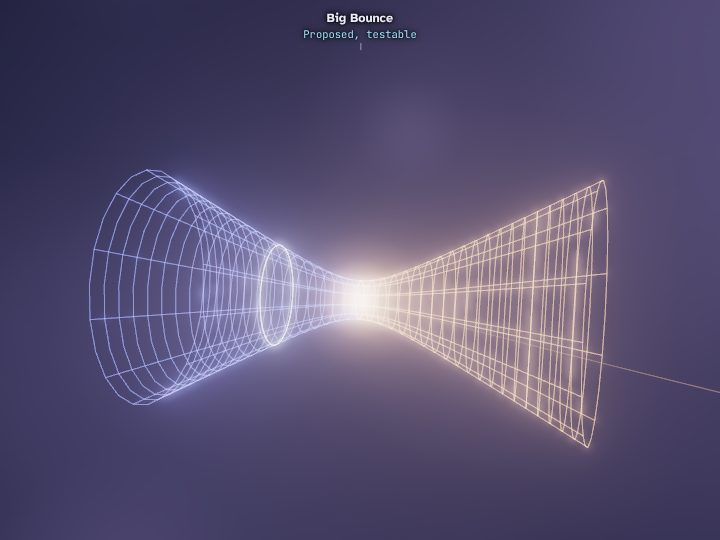
Perhaps our expanding universe came from a contracting one. Quantum gravity could stop the collapse before infinite density, so the Big Bang was really a bounce.
In loop quantum cosmology, space comes in tiny quantum units. As density nears the Planck density, gravity becomes repulsive and the contraction turns to expansion. The theory is still unfinished, but it gives definite numbers for the bounce, and scientists can compare them with the CMB.
What the picture shows
The blue half is an earlier universe shrinking. It reaches a smallest size that is not zero, the glowing waist, and re-expands as ours.
How it could be tested
Models predict tiny differences in the largest-scale CMB patterns. Current data cannot yet tell them from inflation alone.
Sources
Cyclic and ekpyrotic universes
 Open this model in 3D →
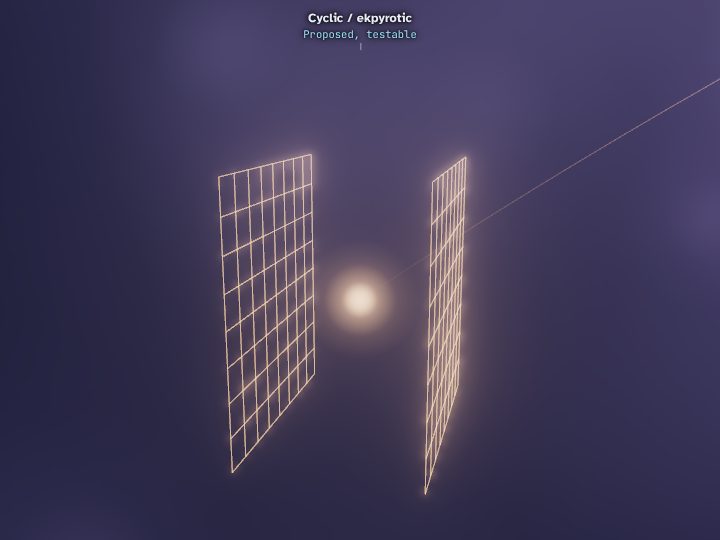
Our Big Bang might be one in an endless series. Two universe-like “branes” collide, make a hot Big Bang, then drift apart and repeat. These models do not need inflation to explain the smooth universe.
Ekpyrotic models flatten and smooth space slowly during a contraction. They predict that primordial gravitational waves are essentially absent. That is a sharp test: if r is ever measured to be well above zero, the simplest versions fail.
What the picture shows
Two sheet-like worlds drift together and collide. Each flash is a Big Bang. They drift apart and it happens again.
How it could be tested
If LiteBIRD or ground experiments detect primordial gravitational waves, the simplest ekpyrotic models fail. A non-detection supports them but does not prove them.
Sources
Conformal cyclic cosmology
 Open this model in 3D →
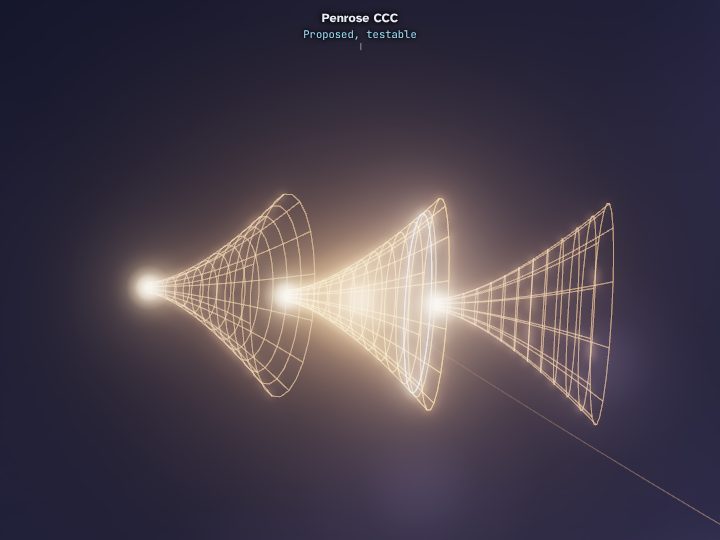
The far future of one universe, cold and empty, could look mathematically just like the Big Bang of the next. Penrose proposed an endless chain of “aeons”. He claimed that rings in the afterglow, called Hawking points, are leftover signs of black holes from the previous aeon.
Penrose and collaborators reported such features in CMB maps. Other teams re-analysed the same data and found the claimed features could arise by chance in standard cosmology. The idea is still discussed, but the observational claim is disputed and most cosmologists do not accept it.
What the picture shows
Three aeons in a row. The wide, empty far future of one becomes the tiny hot start of the next. The gold one is ours.
How it could be tested
Independent searches for circles or points in the CMB. Existing searches by other groups did not confirm them.
Sources
Eternal inflation and the multiverse
 Open this model in 3D →
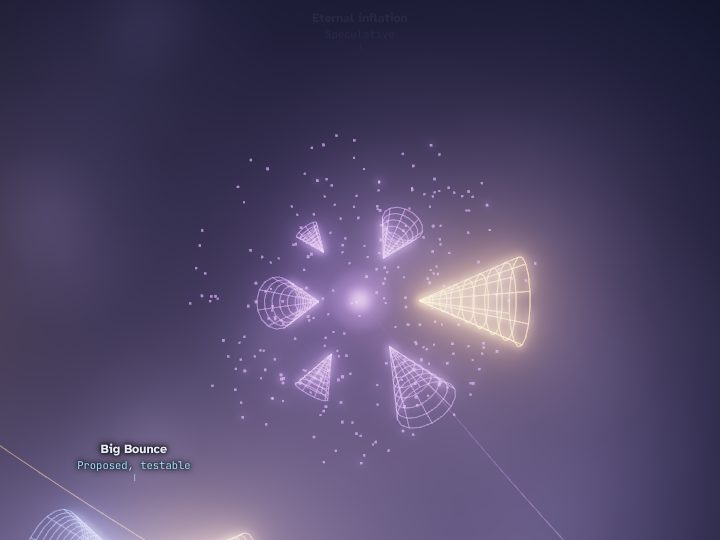
In some inflation models, inflation never stops everywhere at once. New “bubble universes” keep forming, and ours is one bubble. That would make our Big Bang one of many.
This follows from the maths of some leading inflation models, but nobody has found a way to test it. One idea is that a bubble collision would leave a ring-shaped mark in the afterglow. Searches in Planck data found no convincing mark. Many physicists argue a theory with no possible test is not yet science; others say it is a natural consequence of a theory that works.
What the picture shows
The cloud is space that keeps inflating. Cones are bubble universes budding off it. The gold one is ours.
How it could be tested
Search the CMB for the imprint of a collision with another bubble. Searches found none, and most versions make no clear prediction.
Sources
The no-boundary universe
 Open this model in 3D →
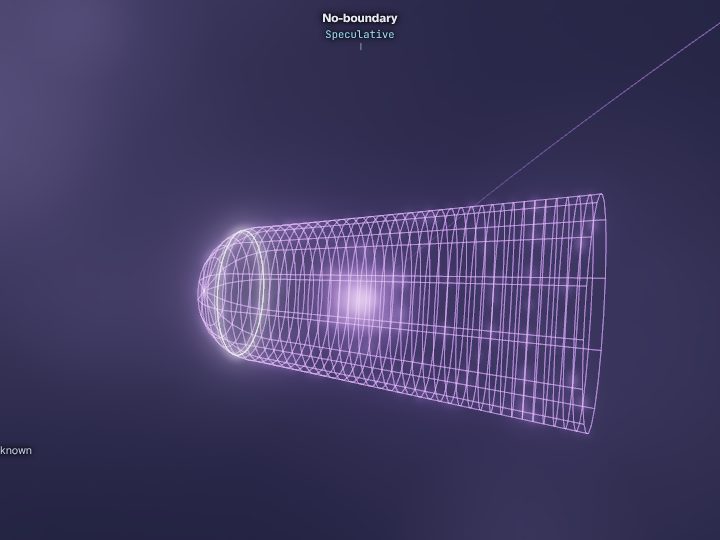
Time may not have a sharp starting edge at all. Going back, time gradually turns into another direction of space. Think of the South Pole of Earth: there is no place south of it, yet it is not an edge.
Hartle and Hawking used quantum mechanics to describe the whole universe at once. The result is a smooth “cap” in place of a first moment. The calculation is delicate and later work has questioned which universes it favours. It remains a thought-provoking proposal, not a tested prediction.
What the picture shows
Follow the shape back to the left: it has no sharp tip. Time rounds off smoothly, so there is no first instant to stand before.
How it could be tested
Hard to test directly. Some versions make statements about the strength of primordial ripples that future measurements could check.
Sources
Black-hole universes and bounces
 Open this model in 3D →
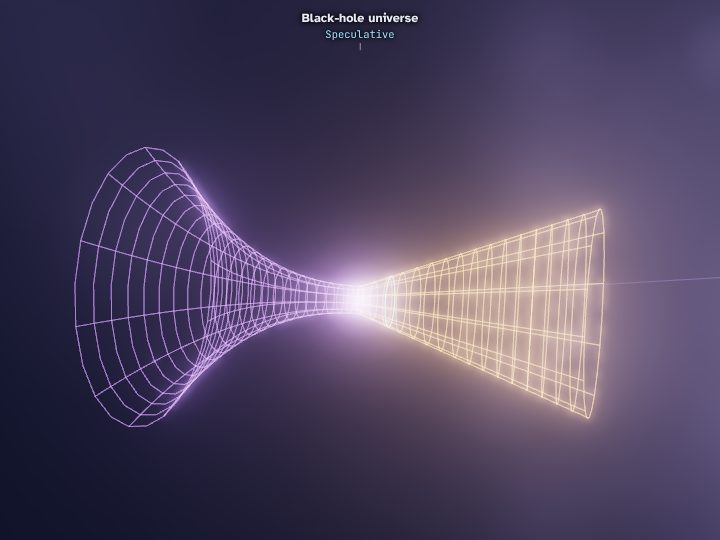
Is our universe inside a black hole? Or could a black hole “bounce” into a white hole, an object that only sends matter out? Some serious physicists have explored whether that could look like a Big Bang from the inside.
Popławski showed that adding spin to gravity (torsion) could turn a black hole’s centre into a bounce that births a new expanding universe. Haggard and Rovelli showed in quantum gravity that a black hole could tunnel into a white hole. White holes are allowed by the equations but have never been seen, and no one has shown that this matches our universe in detail.
What the picture shows
Matter spirals into a black hole in a parent universe (left). At the narrow throat the collapse rebounds and opens out as a new universe (gold).
How it could be tested
Not tested yet. Proposals include looking for a tiny preferred direction in the sky, and for relics of old black holes that exploded as white holes.
Sources
How we will find out
Scientists can test ideas about the very beginning only indirectly, by looking for faint clues in old light. The clue that matters most is a twisting pattern in the afterglow of the Big Bang, made by gravitational waves from the first instant.
Now. BICEP/Keck, South Pole Telescope, Planck and ACT have set r < 0.034 (95%) and measured the tilt ns = 0.9682 ± 0.0032. This already rules out some inflation models.
Running now. The Simons Observatory in Chile is mapping the afterglow’s polarisation for primordial gravitational waves. The Square Kilometre Array and HERA radio telescopes are working toward the 21 cm signal from the Dark Ages.
Early 2030s. LiteBIRD (JAXA) will measure the afterglow’s polarisation over the whole sky, if it flies as planned. It aims to detect r down to about 0.001 or push the limit below it.
Around 2035. LISA (ESA) is a space-based gravitational-wave observatory. It could look for a background of gravitational waves from the early universe, at a very different frequency than the CMB.
Detecting those primordial gravitational waves would strongly support inflation and rule out the simplest cyclic models. Finding none, down to very small values, would push scientists toward other ideas. Dates are plans and can slip.